
The Reality of Education Inequality in India
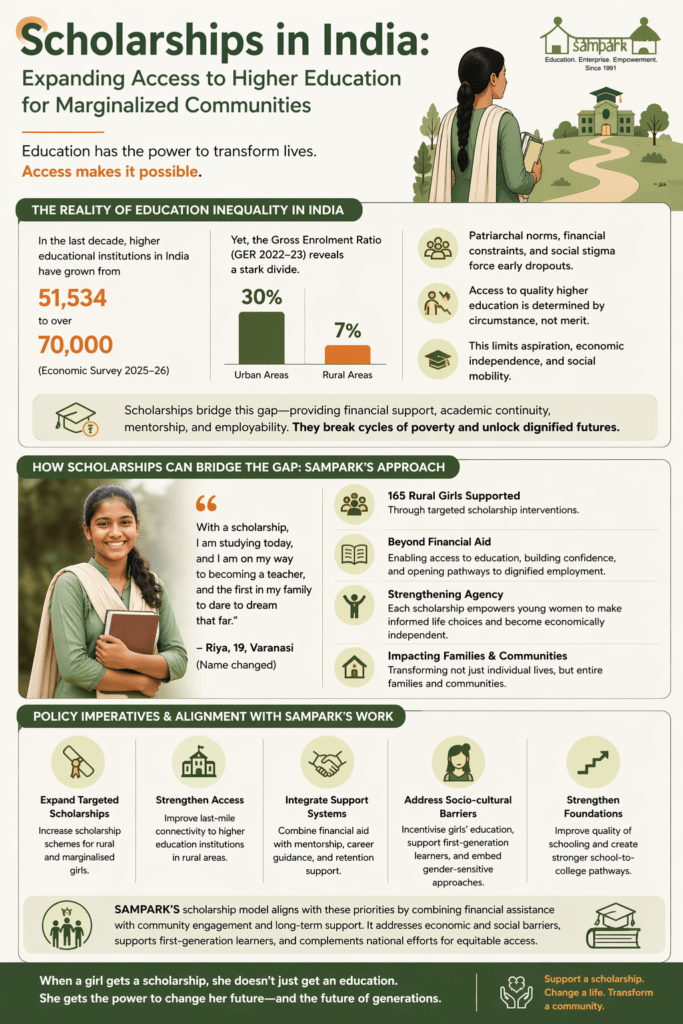
In India, within the last decade, the number of higher educational institutions has grown from 51,534 to over 70,000 as per the Economic Survey 2025–26). Yet, the Gross Enrolment Ratio (GER 2022–23) reveals a stark divide with only 30% enrolment in urban areas as compared to just 7% in rural regions.
This widening gap between opportunity and access reflects a deeper systemic challenge, particularly for young rural girls from marginalised communities. Patriarchal norms, financial constraints, and entrenched social stigma continue to force early dropouts, limiting both aspiration and access.
While education remains one of the most powerful pathways to economic independence and social mobility, access to quality higher education in India is still largely determined by circumstance rather than merit. Under such circumstances, scholarships play a critical role in bridging this educational equality offering not just financial support, but also enabling academic continuity, mentorship, and long-term employability. They serve as catalysts for breaking intergenerational cycles of poverty and unlocking pathways to dignified futures, especially among students from marginalised communities.
How Scholarships Can Bridge the Gap: Sampark’s Approach
In Varanasi, 19-year-old Riya, the daughter of a Self-Help Group (SHG) member and a first-generation learner, represents what access can achieve.
“With a scholarship, I am studying today, and I am on my way to becoming a teacher, and the first in my family to dare to dream that far.”
Riya is one among 165 rural girls supported by Sampark through targeted scholarship interventions. Beyond financial aid, these scholarships enable access to education, build confidence, and open pathways to dignified employment.
Sampark’s work goes beyond funding education as it strengthens agency. Each scholarship empowers young women to make informed life choices, become economically independent, and contribute meaningfully to their families and communities.
Policy Imperatives and Alignment with Sampark’s Work
Addressing the rural-urban divide in higher education requires a multi-layered policy response. This includes expanding targeted scholarship schemes for rural and marginalised girls, strengthening last-mile access to higher education institutions, and integrating financial aid with mentorship, career guidance, and retention support.
Additionally, they must also address socio-cultural barriers by incentivising girls’ education, supporting first-generation learners, and embedding gender-sensitive approaches within education systems. Improving the quality of rural schooling and creating stronger school-to-college transition pathways are equally critical to ensuring sustained enrolment.
Sampark’s scholarship model is closely aligned with these priorities. By combining financial assistance with community engagement and long-term support, it directly addresses both economic and social barriers that hinder access to higher education. Its focus on first-generation learners and rural girls complements national efforts to improve enrolment, retention, and equitable access.