
The Problem With India’s Early Childhood Care and Education
India has over 400 million internal migrants, including an estimated 63 million migrant children (Census 2011). Karnataka, one of India’s fastest urbanising states, hosts millions of seasonal and circular migrant workers, particularly in construction. In Bengaluru, migrant families often live in temporary settlements near worksites with limited access to schooling, immunisation continuity, balanced meals, early learning spaces, and consistent adult supervision.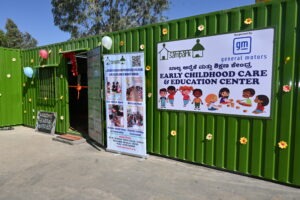
NFHS-5 reports that 32.1% of children are underweight, 35.5% stunted, and 19.3% wasted. For migrant children, frequent mobility increases the risk of malnutrition, incomplete immunisation, poor healthcare access, and early school dropout. The UNESCO Global Education Monitoring Report (2019) estimates that up to 40% of children from seasonal migrant households drop out of school.
Sampark’s Mobile ECCE Solution Offers Permanence and
Perseverance in Care
In the Chikkanayakanahalli migrant labour settlement, 46 children are stepping into an early daycare centre for the first time. With the launch of Sampark’s smart, mobile, digitally enabled Early Childhood Care and Education (ECCE) unit, in collaboration with General Motors, a safe learning, healthcare, and nutrition space now operates within walking distance of their homes.
This initiative addresses the disrupted early care of migrant children whose development is often shaped by displacement. Continuous mobility limits access to stimulation, nutrition, and structured learning, contradicting their critical developmental needs, especially during the first 1,000 days of life, as emphasised by the National Education Policy (NEP).
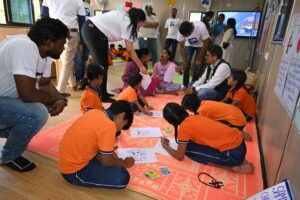
This first-of-its-kind mobile ECCE unit integrates early education and school readiness, daily nutrition and growth monitoring, immunisation tracking, healthcare access, and digital learning tools into one child-friendly space. All 46 children are enrolled, with access from 9 AM–5 PM, six days a week, ensuring continuity of care.
The centre provides a supervised environment in the presence of teachers and supervisor, where children learn safely, away from construction sites and closer to formal schooling. It also enables mothers to pursue employment opportunities without the burden of unsafe childcare arrangements.
Rahul (name changed) may not yet understand “addition,” but confidently says 4 + 4 equals 8. Seema (name changed) recites the alphabet proudly. Until now, learning was uncertain. The nearest school was 10 kilometres away, and education relied on occasional tuition sessions in neighbouring homes. The closest Anganwadi, 2 kilometres away, catered only to children under five, leaving mothers without safe options for older children.
When asked what she looks forward to most, Seema says, “I am excited to learn English and math, and make new friends.”
Strengthening Community Engagement and Collective Responsibility for
Inclusive ECCE
Strengthening ECCE for migrant children in Bengaluru requires more than service delivery. It demands collective ownership aligned with policy and grounded in developmental needs. When communities, parents, frontline workers, civil society, and corporates collaborate, ECCE centres become integrated hubs, prioritising play-based learning, school readiness, nutrition, health, and socio-emotional development.
Community participation improves enrolment, attendance, and culturally responsive learning for migrant children facing mobility and language barriers. Corporate and civic partnerships strengthen infrastructure, digital tracking, nutrition support, and educator capacity. By embedding accountability and local leadership within migrant settlements, ECCE shifts from a welfare response to a rights-based ecosystem, ensuring Bengaluru’s migrant children build the cognitive, emotional, and health foundations needed to thrive in school and beyond.